Brief & Concept
The client — own brand or influencer — submits a creative brief: universe, target, selling price, quantities, market (B2B boutique, e-commerce, gift). MARKAGENIE produces a stripe moodboard (Breton stripes, military marinière, sport marinière), a colour palette and a validated concept sheet. For an influencer collection, this step includes the naming and full commercial positioning.

Technical Design & Pattern Making
Every model is drawn in technical view (front/back/details) with all jersey measurements and tolerances. The base pattern is adapted for cotton jersey (230 g/m² minimum) integrating the stretch coefficients specific to each fabric. Grading XS→XL calculated. Deliverable: complete Technical Sheet (TS) + DXF digital pattern. Stripe alignment at seams is documented in the TS — this is the #1 quality checkpoint for the marinière.

Sourcing & Material Qualification
Selection and supply: striped marinière cotton jersey 220–250 g/m², high-tenacity polycotton thread, ribbed cuffs (wrists, hem, neckline), polyester elastic for low-back models. For DTG models (direct-to-garment printing), 100% white cotton is mandatory — this is one of the rare pieces where DTG rivals sublimation. OEKO-TEX certified suppliers, material sheet validated by the quality department.

Oscillating Knife Cutting
The jersey fabric is spread in multiple layers (2 to 6 depending on the model) on the digital cutting table. The oscillating knife cuts without heat — unlike laser, there is no risk of scorching or discolouration on cotton edges. Precision ±0.1 mm, clean cut of bias and armhole curves. The stripe alignment specified by the TS is maintained layer by layer via control markers.


Assembly: shoulder & side seams
The main pieces (front, back, sleeves) are assembled on a reinforced lockstitch machine — shoulder seams first (straight stitch + overlocking in a single operation or two sequential stations), then side seams in one shot. Stretch jersey requires slight differential tension on the presser foot to avoid puckering. This station is the most time-consuming on stripes: the operator checks alignment at every side closure.


Ribbed cuff attachment & neckline finishing
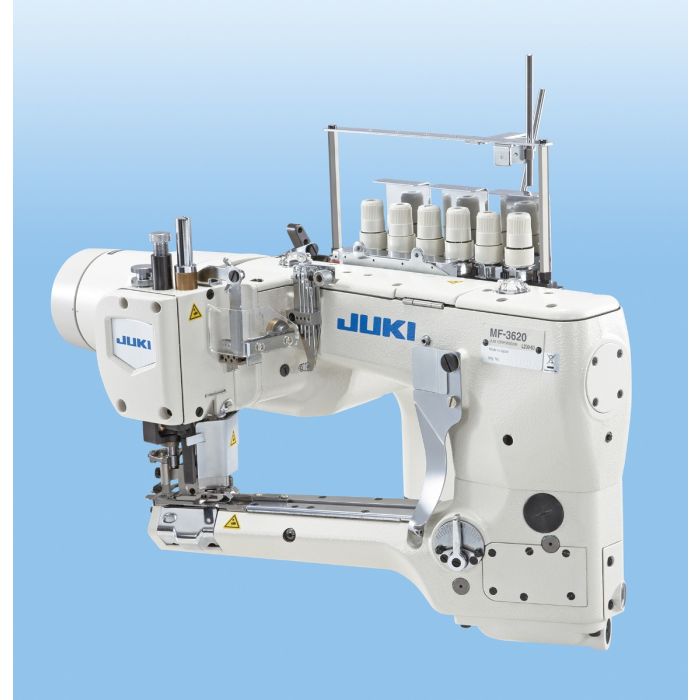
The round neckline, wrists and hem receive their ribbing in coverstitch — 2-needle topstitching visible above, overlocking below in a single pass. This operation requires precise tension on the ribbed band so it stretches uniformly without puckering. The servo motor ensures constant speed even around corners. This finishing detail is what distinguishes a handmade marinière from a quality industrial one.

Repetitive stitching & details
High-speed repetitive stitching — care labels, sewn-on decorative bands, patch pockets — is handled by the CNC sewing robot. Each programme is recorded once, validated, then repeated identically across the entire run. Zero variation piece to piece, zero operator fatigue. For kangaroo pocket or offset stripe models, the robot manages positioning via optical markers.


Overlocking & interior finishing
All interior assembly seams are overlocked at 7,000 stitches per minute — semi-dry (zero risk of oil stain on white jersey). This station also handles rolled hems on long sleeves and hem finishing when the piece has no ribbed cuff. The overlocker throughput is the true production rate regulator on jersey: target 1 fully overlocked piece every 90 seconds.


CNC Embroidery & DTG Printing
Two complementary embellishment technologies at the service of the marinière:

CNC Embroidery (9 heads): anchor logo, collection serial number, raised marine patch. Embroidery on jersey requires a cut iron-on stabiliser (embroidery backing) to prevent the stretch fabric from distorting the motif. Result: permanent relief, washable at 60°C, premium look.
DTG — Direct-to-Garment: for printed variants (nautical charts, illustrations, text), direct printing on white cotton delivers photographic resolution on the finished piece. Unlike sublimation (polyester only), DTG is the premium process for 100% cotton.
Shaping & Steam finishing
Every piece passes through the steam form to recover its exact shape after sewing operations. This step re-energises creased cotton fibres, sets the ribbed cuffs to their final dimensions and eliminates handling creases. Stripes are visually straightened — a detail invisible to the touch but decisive for the product photo.

Quality control
Every piece is measured at 8 control points (chest, sleeves, back length, neckline, wrists, hem). Seam strength test (12 kg pull on jersey), stripe alignment verification at lateral seams (tolerance ±2 mm), embroidery check (taut thread, no skip). Target rejection rate: <2%. NG pieces return for correction or downgrading.

Packaging
Folded to brand template (flat-pack or hung), slipped into a compostable pouch or recycled kraft box depending on positioning. Edge-sewn woven label (composition, washing guide, size), hangtag with QR code to the lookbook or collection story. For influencer collections: fully branded packaging (tissue paper, wax stickers, printed handwritten insert).

Market launch — two routes
This strategic choice is defined from the brief (step 01). It determines the packaging, pricing, product photography and stock management.
- Product shoot (white background + nautical ambiance)
- SEO-optimised product page with size chart
- Listed on collection.markagenie.com
- Stock management & D+2 dispatch
- 30-day returns, sales analytics
- Made-to-order restocking, no overstock
- Naming + brand visual identity
- Branded Shopify store — turnkey
- Exclusive MARKAGENIE distribution contract
- Direct delivery from workshop (no-stock)
- Launch pack: photos, unboxing videos, social assets
- Revenue split: guaranteed influencer margin